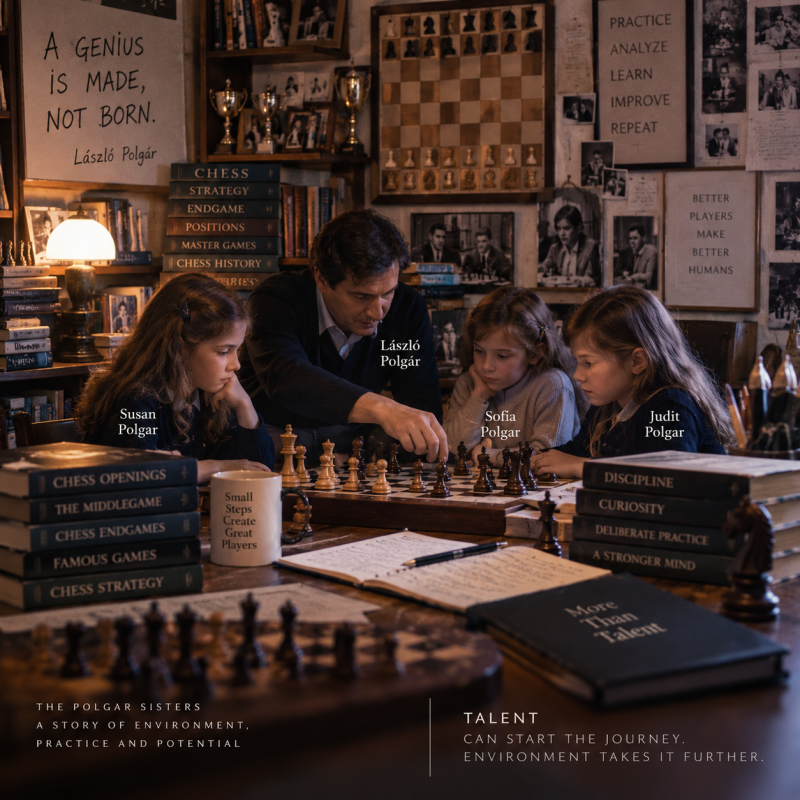
1970-ci illərdə Budapeştdə László və Klára Polgár ailəsi qeyri-adi bir təhsil eksperimenti həyata keçirməyə başladı.
László Polgárın əsas fikri sadə, amma o dövr üçün olduqca radikal idi:
“Dahilərlə doğulmurlar, dahilər yetişdirilir.”
O, üç qızının — Susan, Sofia və Judit Polgárın — inkişafını ənənəvi məktəb sistemi əvəzinə evdə təşkil etdi. Əsas istiqamət kimi isə şahmat seçildi. Polgár şahmatı təsadüfən seçməmişdi: nəticəni ölçmək mümkün idi və inkişafı konkret göstəricilərlə izləmək olurdu.
Amma ən maraqlı hissə şahmatın seçilməsi deyil, mühitin necə qurulmasıdır.
Ailənin Budapeştdəki mənzili adi evdən çox, kiçik bir şahmat laboratoriyasına bənzəyirdi.
Rəflər minlərlə şahmat kitabı ilə dolu idi. Divarlarda tarixi şahmat səhnələrinin təsvirləri, əvvəlki oyunların analizləri və kartotekalar yerləşirdi. Bir divar bütövlükdə oyunların və rəqiblərin məlumatlarının saxlanıldığı sistemə ayrılmışdı. Qonaq otağında şahmat lövhələri və kuboklar vardı.
Yəni uşaqlara sadəcə:
“Şahmat öyrən.”
deyilmirdi.
Onların gündəlik mühiti şahmat öyrənmək üçün dizayn edilmişdi.
Susan dörd yaşında şahmatla məşğul olmağa başladı. Bir müddət sonra Budapeştdəki şahmat klubuna getdi və böyüklərlə oynamağa başladı.
Kiçik bacıları Sofia və Judit əvvəlcə bu prosesin kənarında qalırdılar. Atalarının Susanla məşğul olduğu otağın qapısındakı kiçik pəncərədən içəri baxırdılar. Onlar da oyuna maraq göstərdikdə László onlara qoşulmağa imkan verdi — şərtlə ki, onlar da şahmat öyrənsinlər.
Beləliklə, üç bacı eyni mühitdə böyüdü:
eyni müəllimlər,
eyni ev,
eyni materiallar,
eyni yüksək gözləntilər,
minlərlə saat praktika,
davamlı geribildirim və analiz.
Onların təhsili də yalnız şahmatdan ibarət deyildi. Evdə dil, riyaziyyat və digər fənlər də öyrədilirdi. Fiziki fəaliyyət də gündəlik proqramın bir hissəsi idi.
Nəticə isə olduqca diqqətçəkəndir:
Susan Polgár qrossmeyster oldu.
Sofia Polgár beynəlxalq usta tituluna yüksəldi.
Judit Polgár isə 15 yaşında qrossmeyster olaraq tarixə düşdü və uzun illər dünyanın ən güclü qadın şahmatçısı oldu.
Burada mühüm bir elmi ehtiyat payı var.
Polgar ailəsinin hekayəsi “genetika önəmsizdir” fikrini sübut etmir. İnsanların koqnitiv xüsusiyyətləri, temperamentləri və öyrənmə qabiliyyətləri arasında bioloji fərqlər mövcuddur.
Amma bu tarixçə başqa bir mühüm sual yaradır:
Əgər potensialın inkişafına bu qədər güclü təsir edən mühit yaratmaq mümkündürsə, onda bizim “istedad” adlandırdığımız şeyin nə qədəri həqiqətən anadangəlmə, nə qədəri isə inkişaf etdirilmişdir?
Bu sual şahmatdan çox daha böyükdür.
Təşkilatlarda da biz bəzən bir işçiyə baxıb:
“Bu adam liderlik potensialına malikdir.”
və ya
“Bu adam analitik deyil.”
deyirik.
Halbuki insanın bacarığı yalnız onun sahib olduğu xüsusiyyətlərdən deyil, düşdüyü mühitdən, aldığı geribildirimdən, qarşılaşdığı çətinliklərdən, məşq imkanından və inkişaf sistemindən də formalaşır.
Polgar ailəsinin hekayəsindən mənim çıxardığım əsas nəticə budur:
Potensial başlanğıc nöqtəsidir. Mühit isə onun nə qədər inkişaf edəcəyini müəyyən edən əsas amillərdən biridir.
Bəlkə də HR-da əsas sual “Bu insan nə qədər istedadlıdır?” deyil.
Daha doğru sual:
“Bu insan düzgün mühitə düşsə, nə qədər inkişaf edə bilər?”
#İnsanResursları #İstedadİdarəetməsi #Potensial #ÖyrənməVəİnkişaf #Liderlik #Bacarıqlar #Karyeraİnkişafı #Performans #TalentManagement #LearningAndDevelopment
Əhəd Quluzadə
English version
In the 1970s, in Budapest, László and Klára Polgár began an unconventional educational experiment.
László Polgár’s idea was simple, yet quite radical for its time:
“Geniuses are made, not born.”
Instead of following the traditional school system, he structured the education of his three daughters — Susan, Sofia, and Judit Polgár — primarily at home. Chess was chosen as the central discipline. It was not a random choice: chess provided clear, measurable outcomes and allowed progress to be systematically observed.
But the most interesting part was not the choice of chess itself. It was how the environment was designed.
Their Budapest apartment was less like an ordinary home and more like a small chess laboratory.
The shelves were filled with thousands of chess books. The walls displayed chess positions, game analyses, and historical material. There were records of games and opponents, chessboards, trophies, and extensive learning materials throughout the home.
The girls were not simply told:
“Learn chess.”
Their everyday environment was designed around learning chess.
Susan began playing chess at the age of four. Soon afterwards, she started attending a chess club in Budapest and playing against adults.
Her younger sisters, Sofia and Judit, initially watched from the sidelines. They would look through a small window in the door while their father worked with Susan. When they became interested in the game themselves, László allowed them to join.
The three sisters therefore grew up in essentially the same developmental environment:
the same teachers,
the same home,
the same learning materials,
high expectations,
thousands of hours of practice,
continuous feedback and analysis.
Their education was not limited to chess. They also studied languages, mathematics and other subjects at home, while physical activity was part of their daily routine.
The results were remarkable.
Susan Polgár became a Grandmaster.
Sofia Polgár became an International Master.
Judit Polgár became a Grandmaster at just 15 and went on to become the strongest female chess player in history.
There is, however, an important scientific caveat.
The Polgár experiment does not prove that genetics are irrelevant. Cognitive characteristics, temperament, learning capacity and other biological differences can influence performance.
But their story raises a more important question:
If the environment can have such a powerful influence on the development of potential, how much of what we call “talent” is innate — and how much is developed?
This question goes far beyond chess.
In organizations, we often look at an employee and say:
“He has leadership potential.”
Or:
“She is not analytical.”
Yet an individual’s capabilities are shaped not only by their existing characteristics, but also by the environment they work in, the feedback they receive, the challenges they face, the opportunities they have to practice, and the development systems around them.
For me, the key lesson from the Polgár story is this:
Potential is the starting point. The environment determines how far it can develop.
Perhaps the better question in HR is not:
“How talented is this person?”
but:
“How much could this person develop in the right environment?”
#HumanResources #TalentManagement #Potential #LearningAndDevelopment #Leadership #SkillsDevelopment #CareerDevelopment #PerformanceManagement #GrowthMindset #PeopleDevelopment
Ahad Guluzade